This is a recurring segment, where I deride the work of much more talented and successful human beings out of personal bitterness. If you’re a hateful sort, I’m inviting you along with a gentle pat on the sofa cushion beside me. Join me, dear friend.
I recently re-read The Great Gatsby, for the first time since it was assigned in high school. I remember Eckleberg’s eyes over the Valley of Ash, and the ceiling being described as a frosted wedding cake. I remember the teacher discussing the literary devices in the description of the house with the French doors. I didn’t know what French doors were of course, so it damaged the visual impact (I just thought they were doors from France, doors that cost a pretty penny to ship overseas). I remember my literature teacher’s visible excitement. But I don’t think I really read the book. And it’s strange, because as much as I thought this second reading would flesh out the novel for me, it did not. It’s a novel with few footholds, and little meat on the bone. Despite all the high school discussion fodder I remember, now the novel seems resilient to examination.
There seem to be two novels present in The Great Gatsby: the novel Fitzgerald has given us, and the novel he thinks he has given us. Needless to say, Fitzgerald thinks he’s written a shining star to put on our town Christmas tree. But when the dialogue and the scenes start, they’re full of gossip, boredom, and self-indulgence. Or if there’s a party scene, there is gossip, drinking and dancing. The disconnect happens when majestic paragraphs unfold between these trivial scenes: Nick gets carried away with thematic words that clash like big brass cymbals! Love! Obsession! Idealism! It’s like you’re getting the novel and the literary criticism at the same time.
When the characters get together in one room, like a gossip magazine come to life, they bicker about who’s sleeping with who, or how in the world they’re going to get more cigarettes, or did you hear the new rumor about Gatsby? Occasionally Tom prattles on about some racist book he just read. to my mind, these scenes are not written very well. Or they are written well, and they’re just well-written scenes about uninteresting people. if this was a stage play, it would fall apart. there’s nothing… exciting that happens in these stretches of dialogue. And for a story full of infidelity, there’s really no suspense.
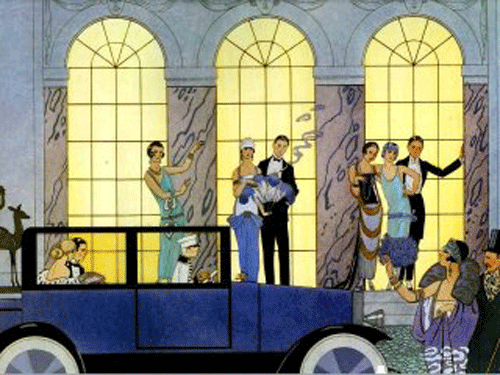
Daisy and Gatsby’s intimate reunion is immediately out in the open as soon as it happens, and the tense showdown in New York City between Daisy’s husband and her lover is silly. This scene is positioned as if it were the centerpiece of the story. But it left my very cold. As violent as Tom proves himself to be in earlier chapters, i was very surprised he didn’t take a swing at Gatsby. Instead, the two men sit in a room in front of everyone, discussing whom Daisy loves more. This continues for what feels like hours. More surprising still than Tom’s lack of violence, is that at the height of his rage, he just lets Daisy leave the city in a car with Gatsby. None of this behavior struck me as human.
Daisy’s lack of agency in this scene is painful to read, as Gatsby and Tom try to use Jedi mind control on her. They pretend to know all of the inner workings of her emotional mind, which they have no knowledge of, and instruct her what to do as if she’s clueless (“She’s leaving you.” “No she is not.”). I know this sort of thing may have been typical of the time period, but it’s silly and disgusting to read. It doesn’t lend any credit to Gatsby either, who’s supposed to be a gentleman.
From the argument in chapter 7:
Gatsby: “She only married you because I was poor and she was tired of waiting for me. It was a terrible mistake, but in her heart she never loved any one except me!”
“Even that’s a lie,” said Tom savagely. “She didn’t know you were alive.
Gatsby: “You don’t understand. You’re not going to take care of her any more.”
Tom: “She’s not leaving me!”
Charming.
Kathryn Shulz makes a great point about Fitzgerald’s untimely misogynism in her write-up on Gatsby, which appeared recently in New York Magazine. She claims Fitzgerald has an “unthinking commitment to a gender order so archaic as to be Premodern: corrupt woman occasioning the fall of man. There is, relatedly, the travesty of his female characters—single parenthesis every one, thoughtless and thin. (Don’t talk to me about the standards of his time; the man hell-bent on being the voice of his generation was a contemporary of Dorothy Parker, Gertrude Stein, and Virginia Woolf, not to mention the great groundswell of activists who achieved the passage of the Nineteenth Amendment. Yet here he is in A Short Autobiography: “Women learn best not from books or from their own dreams but from reality and from contact with first-class men.”)” BOOOO…
So of course there are powerful, creative women doing important things during Fitzgerald’s era, just none to be found in his novel… It’s convenient that Schulz brought up Virginina Woolf also, because the prose styling that is so admired in Gatsby really plays second fiddle to Woolf’s To the Lighthouse.
Also, Nick’s narration is suspect. His sentimental intrusions into the story feel like cheating by the author. They are little course corrections made by Fitzgerald, to remind the reader how (s)he is supposed to feel about the events and the characters. I haven’t read a novel with a bona fide narrator in so long that I’m unsure about what their purpose is, but Nick didn’t seem to help the story. Seeing the events through his eyes felt like looking at the entire story through a dirty window. Aside from being voyeuristic, Nick is supposedly an honest everyman, a faithful messenger for the audience. But his fanboy attitude towards Gatsby is distracting, and when he eulogizes him for the last few pages, I simply could not muster any sadness. Gatsby is a shallow obsessive, a profiteer, and most damning of all: he shows no compassion for the victim of a murder which he is an accessory to.
Lastly, this is a very bourgeois story. Rich people doing rich people stuff throughout. This is all well and good, but it represents a very very small percentage of American life for a novel that is hailed as the great American novel bar none. I don’t think Fitzgerald knew how to write a working class character. George Wilson is sort of close, but his shop is in the middle of a valley of ash. The suburbs, the farmlands, a blank expanse where nothing happens except the migration of dust clouds, it’s all the same to ol’ F. Scott, it seems. There’s old money, there’s new money, there’s the city where the two go to mingle, and everything else is ash. if this is supposed to be an ironic anti-capitalist message, as in… the rest of the country has been destroyed by industrialization and brute capitalism, for the benefit of the wealthy and indulgent, it’s genius. but i don’t think that’s Fitzgerald’s perspective. I don’t even think this is meant to be a cautionary tale about greed, because Gatsby is revered by Nick, and he seems just as bad as the other rich people that Fitzgerald dismisses as “careless” people who “makes messes.” As much as he seems to speak out against the ills of the Jazz Age, refined F. Scotty put on his suit and drank champagne with all of ’em. If he is a satirist, he is also, as they say, a poser, dude.
 keith fields
You must be logged in to post a comment.