The line extended out the door Wednesday night at the Marchesa Hall & Theater, whose beautiful art deco interior is concealed in an unassuming strip behind Highland Mall. On the marquee in plain black capital letters: Stranger Than Paradise, a 30 year old indie film by celebrated American director Jim Jarmusch. But it was Richard Linklater who drew the crowd. The film is the first in a series of four movies – #JewelsintheWasteland – curated and emceed by the self-described dropout punk and Academy Award-nominated director. The series is sponsored by the Austin Film Society. Linklater’s “wasteland” points to the state of American cinema and culture in the 1980’s, the hollowness of fast MTV cuts and blockbuster hype, of Reagan politics and yuppie greed.  During his introduction, Linklater placed Stranger Than Paradise within a genealogy of minimalist cinema starting with Andy Warhol, and celebrated its release as a watershed moment for moviemaking. Attendees were treated to a projection of the original 35mm reel of the film; the celluloid images were romantic but revealed 30 years of abuse. The early apartment scenes writhed with squiggles and grain.
It was my first time to see Stranger than Paradise, and I really enjoyed it. It’s a character-driven charmer about coincidence, family, and identity. The story begins with the arrival of Willie’s cousin, Eva, from Hungary. She stays with him in a postage stamp of an apartment in the Lower East Side of NYC. With a bit of pride, he shows off his American assimilation: TV dinners, baseball, lots of television, and Chesterfield cigarettes that “taste the same everywhere you go.” Despite all this, Willie has no taste for America’s contribution to music: the R&B performer Screamin’ Jay Hawkins, whose record Eva plays over and over on her portable cassette deck.
Her presence rekindles his sense of family, and when she leaves, he eventually follows her to their aunt Lottie’s place in Cleveland. There he gleefully puts away bowls of goulash and spends the evenings playing cards with his Aunt. “Doing nothing” is how his buddy Eddie sees it, who comes along for the trip. After they have their kicks, the three of them drift south to Florida on a whim, to see “paradise,” but they end up in a crappy motel not unlike where he lived in New York. They spend the morning betting on the dog races instead of going to the beach. Eva buys a beach hat and takes a walk.
Up until this point the movie trundles along, like a black and white relic from the late 1950’s (During the Q & A after the film, Linklater mentions that Jarmusch’s black and white is not the sexy silvery kind of vintage Hollywood, but has a different crappier vibe. I agree, and I dug its rawness). The two emotionally opaque lead characters wear vintage clothing and even their form of hooliganism seems vintage: card sharking. But then, there is an interesting moment in the film that rips the viewer out of this false perception. 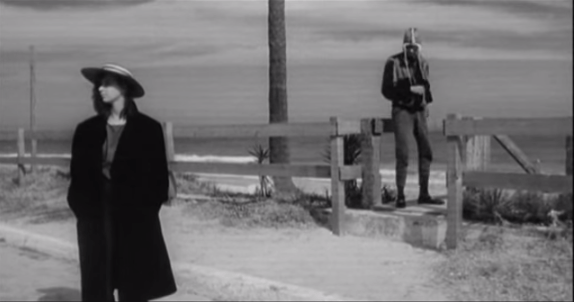 Eva enters a simple beach scene in a long dark trench coat and her new hat, like a female lead in an old French drama. She comes upon a quick-talking drug dealer who sports Levar Burton shades, a patterned winter cap with hanging tassles, tight slacks and a baggy jacket. He feels like an impossibility, a time-traveler, in this movie that already feels 30 years older than it really is. His first line as he approaches her is, “hey, where the fuck you been at, man? Shit, man.” He thrusts an envelope of money into her hand, “here take this shit, man.” He mutters his way out of the scene and is never heard from again. Suddenly, Eva is rich, after being mistaken for a drug pusher. It’s an absurd scene that juxtaposes the urban maximalist style of the 1980’s with European sophistication. It’s like a statement on the times, a visual metaphor for how the inherited tradition of French and Italian cinema does not mesh with the new world of the 1980’s: its graffiti, poverty, neon clothing, and street slang. With this scene, Jarmusch seems to say goodbye to the simple, white-washed world he creates in Stranger Than Paradise right in the middle of the film.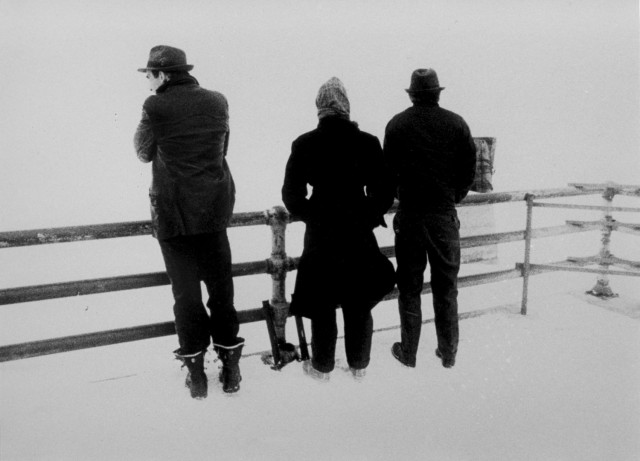
Anyway, I seriously loved the movie. One of my favorite scenes was when they show up as tourists at Lake Erie, and the air is so thick with snow they can’t see a thing. “It’s beautiful,” Eddie says with awe. If you don’t know, you don’t know what you’re missing.
 keith fields
You must be logged in to post a comment.