
Before web browser entered the popular consciousness, browse had a small role in the lexicon as a shopping synonym. Now, it’s the definitive verb of the Internet generation. We spend hours online, disappearing into YouTube wormholes, Buzzfeed pop culture, clicking on chains of links and news stories. Internet-as-activity is a quest for Relevant Content which is only consummated with eye strain or deferred in the panic of a missed deadline.
As a word, browsing prefigured the Information Age. To browse is to observe all available information in a large set, making quick, intuitive judgments and comparisons, and refining criteria until a selection is made. It’s a fluid, somewhat inefficient method of filtering, and, when applied to the act of navigating the web, is really a perfect term. As a type of looking, it is recreational rather than purposeful (one doesn’t browse for missing car keys). In the real world, libraries, record stores, shopping malls, and farmer’s markets are common places to browse, and the browser’s reward may be a ripe tomato, a book to read during a long layover, or a gift for a friend. Even if nothing is found, one feels enriched by the experience.
But the major players in E-commerce offer an experience that is the opposite of browsing. Frankly, it’s not even possible. I’m a fan of Amazon, but I’m still a brick and mortar holdout for goods like books, music, or clothing. For the things I have to buy – home goods, batteries, office supplies – I often turn to Amazon. For the things I want to buy, I like to savor the experience a little. The search format of E-Commerce prohibits any such nonsense. NBD, right? Well, when we support the online marketplace, we might be missing out on more than we realize.
Shopping on the internet versus I.R.L. is obviously different in a lot of ways, but I just want to focus on the search format. Consider a typical interaction with the iTunes store or Amazon, which is dependent on user-provided search terms (Katy Perry, Malcolm Gladwell, sandals). The user must provide information as a starting point before the search engine can initiate any meaningful content. A search algorithm is a fancy trick, because it makes you forget that your request is the bottleneck of its process. The user is limited to the results of their own search query, and as a result, a search is tinged with a sort of solipsism. There is no room for anything unexpected. And the user cannot step outside the request to find the thing that may be perfect, if they only knew what it was. A search on Amazon, “Earth’s Most Customer-centric Company,”can become frustrating if you can’t produce the right terminology. You may resort to searching by substitution: “pasta strainer” instead of colander, or “bookshelf tab” instead of “brass shelf standards.” You could be at the computer with a tool or a random broken part IN YOUR HAND and not know what the hell it’s called. And you can search all day for “chef’s knife” and likely never discover that there exists a thing called a mandolin or a garlic press that is a tremendous help in the kitchen.

Let’s see how the E-Commerce search model might manifest in a real life grocery shopping trip. Imagine walking up to your local market and discovering that now you can’t get in without an idea of what you want. You need some milk, so you type the word into a touch screen at the store’s entrance. You enter, and find yourself in a giant cooler with every imaginable milk product. Organic, skim, whole, soy milk, goat milk, etc. Your terms were too broad. Then you notice that there is no produce, no dry goods, no wine. There is a sign on the wall: “Customers who buy milk also buy cereal. Would you like to add some cereal to your shopping cart?”  In this scenario, you get exactly what you requested. The user experience is more or less perfect, but there’s something… missing from the experience. It’s streamlined to a fault. Although connecting users with their desires seems like an efficient user experience, it denies the user the opportunity to be without desire. Buddhism posits that attachment to desire causes suffering. Search functions work against this principle, as they are essentially engines to perpetuate desire. But true happiness or creative thought thrives when one is free of all that.
Real world environments like bookstores and libraries, with no pressure or necessity of purchase, offer user experiences that are aimless and organic. In a record store, as opposed to the iTunes store, you might find rare editions of albums, new music, or just the virtues of a tangible product: the album art and the typeface, the worn corners of an original pressing from the 1960’s. The shopper is free to act without intention, but is satisfied nonetheless. These are spaces with the right combination of content and chance. Shopping on the internet offers an infinite amount of the former, and tragically little of the latter.
In the Information Age, shopping in a record store is a doubly vintage indulgence. The modern consumer not only prefers music in MP3 format, but they prefer to do their browsing via the iTunes search engine. They still shop with their fingers, sure, but instead of flipping through random inventory, they confront their content armed with a mouse and keyboard. In opposition to the web, the storefront gives us the joy of surprise. If E-Commerce is a means of satisfying every desire generated by advertising, it is also a prophylactic against spontaneity and community. The opportunity to browse in a brick and mortar storefront is the only offering of capitalism that (I can’t believe I’m saying this) has a quality of Zen.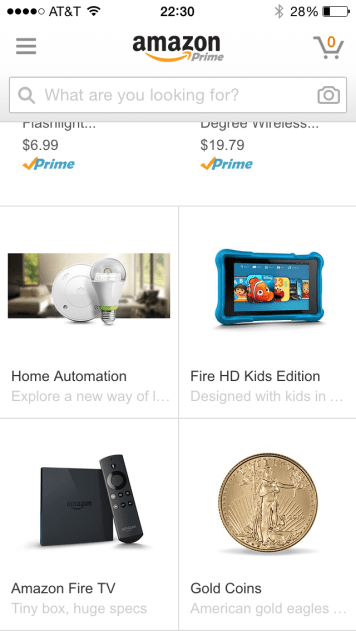 This is what the user sees when they open the Amazon smartphone app. “What are you looking for?” I find it curious that this very question causes most people to shoo away a salesperson, but in an app it’s like a promise of satisfaction. The unspoken attitude is that whatever it is, you’re about to find it. E-Commerce is linear: the user moves swiftly from (1) wanting to (2) finding to (3) buying. To me, this feels limiting, and a little cold. There’s no wiggle room in that sequence. Even though, in seconds, you could find a vintage Talking Heads tour t-shirt or a rare edition of your favorite book, it’s still much more satisfying to come across these in a store. It’s common for people refer to their finds as #scores when they happen. The internet offers no such opportunity. Scoring requires that an obstacle be surmounted, and searching the Internet is essentially playing alone.
Some app designers intuit the joylessness of instant gratification, and compensate by delighting the user with surprises or cuteness in the vein of Japanese kawaii. In the Yelp! app, for example, a gerbil spins in its wheel as the user changes settings, or is seen chewing wires below an error message. Every section of copy, whether it’s a call to action or a badge description, is coy and memorable. These things give the interaction a really human vibe, and this is why Yelp is one of my favorite apps to use. 
 I’m not down on Amazon or the iTunes Store. They are perfect examples of E-Commerce done right. I’m only suggesting that we examine what we sacrifice when we build a world in which desire is vanquished with such urgency, a world which denies us a little serendipity. If, on a morning jog, you stop to buy a croissant because the fresh smell is carried to you through the open door of a local bakery, or, in a bookstore, you find a novel that reminds you of your childhood, you experience something so different from the cheap gratification common to the Internet. But you must be open to that. That fulfillment can never be keyed into a search engine. It is an outcome of the browsing mindstate, in which people are free to pursue and redefine relevance in the real world, surrounded by real people. Life deserves so much more of that.
 keith fields
You must be logged in to post a comment.