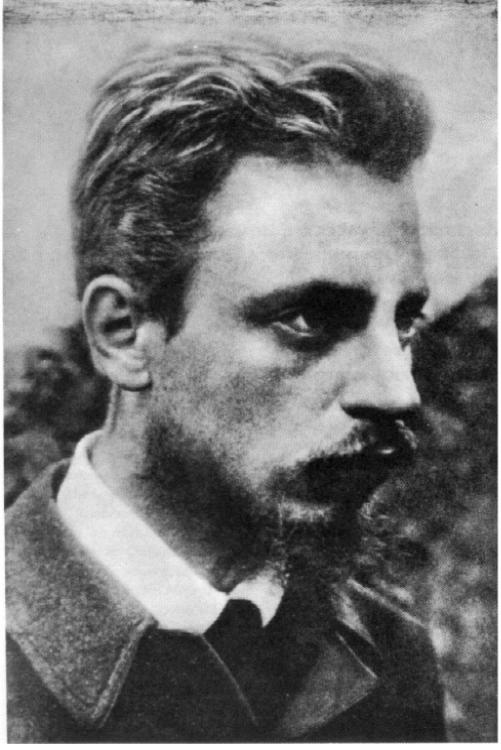
I first read Rainer Maria Rilke in the summer of 2010.
I worked nights at the time. His Selected Poetry (published by Vintage, with a terrific translation and introduction by Stephen Mitchell) accompanied me on every shift. Rich as chocolates, each one of them. I felt guilty if I read too many. Sometimes, I would hold myself to one poem per shift… but that one inhabited me for hours. The poems are so vaporous. The images linger and cloud together — broken up by indefinite semicolons and dashes — and the final lines are like cold glass against the cheek.
His sensitivity to beauty in the world is staggering. In a letter to his wife Clara, he writes, “Yesterday, I was in the Jardin des Plantes for the whole morning, before the Gazelles.” He continues, describing their movements, the color of their hair, their social nuances. I still think about Rilke’s day at the zoo when I am the victim of an unfocused day. I remind myself that he spent an entire morning watching gazelles. “I couldn’t depart, so beautiful were they.”Even before smartphones reduced our attention span, I’m sure that was a strange commitment of one’s time.
I recognize a lot of romantic sublimity in his earlier poems, in the descriptions of potential in the animals’ limbs and gazes, the latent power concealed in natural tranquility. To this day, I still feel Rilke is a radical departure from the English-writing poets that I’m familiar with. Reading his poetry is intimate and alienating, like going to bed with someone who doesn’t speak your native language. You are naked and touching but you can barely communicate. He’s so sincere. His yearnings, untempered by self-consciousness, are sometimes painful to read. Part pioneer, part shepherd, the androgynous Rilke is a wanderer collecting impressions, a drifter with a loaded shopping cart stored away in his mind.
sometimes a man stands up during supper
and walks outdoors, and keeps on walking,
because of a church that stands somewhere in the East.
And his children say blessings on him as if he were dead.
And another man, who remains inside his own house,
stays there, inside the dishes and in the glasses,
so that his children have to go far out into the world
toward that same church, which he forgot.
 keith fields