
The visual branding of radio has changed little in the last century, since the first commercially licensed station went on air in 1920. Today, a station’s call sign and broadcast frequency are embellished with color, a graphic of a microphone or broadcast tower, and maybe an occasional lightning bolt.


These simple graphics have always sufficed for swag, but because a radio station’s visual brand is not part of the user experience, it’s rarely top of mind. N.P.R. may have achieved some classic status with its tri-color logo within the media industry, but it’s no Coca-Cola. While television viewers may see the NBC peacock or the CBS eye in the corner of their screen, radio listeners, whether on the highway or at home, have no similar experience when tuning into a station.
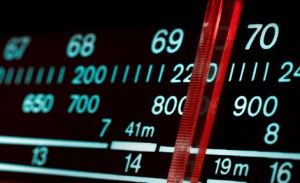
But that was radio. You can’t stumble into a podcast in the same mindless way that you can find something to watch on TV (streaming media platforms have yet to work out a substitute for the coincidence and ease of channel surfing). Selecting a podcast to listen to is a much more intentional act. And consuming podcasts, whether they’re streamed on an app like Overcast or downloaded on iTunes, is a much more visual experience.
Each of the 150,000+ active podcasts are distinguished only by their icons. Podcast producers have precious few pixels to convey their style to potential listeners. 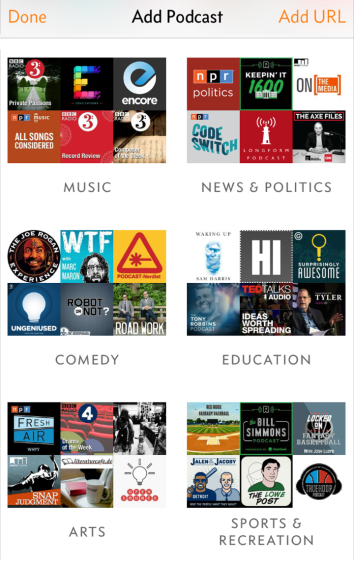
So, good podcast cover art must be effective with limited space. If Hillary Clinton started a podcast, her avatar—the “H” containing an arrow moving forward—would make a far better cover than, say, one of her yard signs. The H is effective because it’s simple, memorable, and it communicates an essential feature of her candidacy: her progressive vision.


For inspiration, podcast producers should look to Alvin Lustig. Lustig was a designer who made a huge impact on book jacket design in the 20th century. The prevailing wisdom of his time, illustrated above by the (unfortunately-titled) A Dog Puncher on the Yukon, and Goodbye Mr. Chips!, was that book jackets should have a narrative design informed by the plot. I have to admit that dog sled silhouette with the purple and yellow tones is pretty cool. Ol’ Mr. Chips looks like he’s had a long day. Or maybe he’s dead, I dunno. I mean, we are saying goodbye to him. You can see how this would be effective… it gets you wondering.
Here are some of Lustig’s designs:


His approach was seductive rather than literal. He believed that design should suggest, not tell. His one- and two-color drawings of roots, figures and hands, fire, and cities provoke curiosity and primal feeling. The type is straightforward and clean. The illustrations stand up on their own merits as pieces of art.
The best podcast cover art uses the same principles of simplicity, and showing rather than telling. Let’s look at a few exceptional podcast cover designs.


The cover of What’s the Point is striking. Symmetry and converging lines draw attention to the title at its center. Multiple white points lit within the grid imply a focus on data, and the complementary colors remind me of binary systems, like the sides of a brain or the houses of Congress.
Allusion is a great way to build meaning with economical space. Apple’s apple recalls the curiosity of Newton, the knowledge attained by Adam and Eve. Goodyear Tires borrows the winged sandal of Hermes to suggest speed and reliability. The Truth borrows the pipe and cursive typeface from Rene Magritte’s Treachery of Images painting, infamous for its comment on reality and representation. The grid and translucent circle is from film leaders, those numeric countdowns we’ve all seen that blip like radar and help projectionists sync up the sound to their reels. The mix of symbols prepares listeners for storytelling that is nostalgic but modern.
The Song Exploder cover is one of my favorites. I love the mix of vibrant colors and precise execution. The letter E is composed of blocks, which break apart further at its endpoints, suggesting granularity and an emphasis on component parts. It’s appropriate for a show that dissects a single song per episode.
The slender, woodsy letters of Lore‘s minimalist cover typeface match the tone of the podcast. Handicrafts are the art of common people, and lore is their voice. When the image is blown up, it reveals the shadowy limbs of trees. There is more than meets the eye.
Within the Wires shows the appendages of an insect blending with the leads and traces of a circuit board. The image is clean, geometric, and compelling. Rather than a complete form, the severed lower body of the insect hints at drama.
And here are some covers that I don’t love.


The hazy geometric shape on the cover of Benjamin Walker’s Theory of Everything is dominated not only by the quantity of text, but by its changing color and size. Bad! What is it? Who cares.
Without any visual clue, the pun in Sound Opinions is lost on the new listener. Also… although it doesn’t provide any additional info about the podcast, the PRX logo in the corner is almost as big as the masthead, and the color scheme clashes horribly. It’s definitely an example of sponsor clutter.
The Serial logo has always bothered me. It bothers me that the S is not centered. It bothers me that the type used for the S looks like it was taken from a Depression era baseball jersey. It bothers me that if you add a fifth card(?) to this stack of cards, its upper edge would fall outside of the frame. It bothers me that the producers were so excited about the concept that all they could think to do for the cover is represent the concept in a dumb, plain, literal way, as if the boring title wasn’t enough. How about some black squares poorly stacked up? How about not.
The sponsor clutter I mentioned about the Sound Opinions cover is an issue with podcasts derived from radio. When the logos of parent stations, sponsors, and collectives appear in the tiny marquee of a podcast cover, the result is more like Nascar than credibility.
On Point with Tom Ashbrook, a conversational news panel podcast, recently redesigned the cover. It’s a great example of how to do them right.


Refreshing, right?
In the new logo, WBUR and NPR are de-emphasized. The horizontal rule, and Tom’s face, are both removed. The title has changed from gray script to a clean, all caps font within a smartly colored banner. It’s much easier to read. A cream background rather than the clinical white/gray gives it a bit of a pulse.
When mature media companies graft design from other platforms to their podcasts, the result can be uninspired. Building on brand awareness makes sense, and there may be a significant overlap of public radio and podcast listeners, but they may not keep coming back for something that feels like an afterthought. As more listeners move into the podcast space, this redesign will pay off for On Point. Young listeners may pass over or be suspicious of a show that seems like a direct transplant from radio. And as the media landscape changes, young people who have less exposure to radio probably won’t kiss the ring of an institution like N.P.R.
The audience for podcasts grew 23% between 2015 and 2016 (that’s over 10 million additional listeners). We could credit the hype of podcasts like Serial and Invisibilia, but there is much more to the story—innovative journalism, experimentation, and creative storytelling are working steadily, building a foundation in the dark beneath these brief fireworks.
Podcasts are having a moment. They represent the best principles of the Information Age. They’re free and fairly easy to listen to; they’re unobstructed by corporate influence or barriers of entry; they move beyond facts and stats to a more holistic view of life; they confront our world’s accelerating complexity; they comfort, edify, and delight. They are exploding with effervescent, un-ironic creativity, and they deserve an authentic, fresh visual presence that energizes listeners, and pulls new people into the space. When people check out a podcast directory for the first time, they need to see confidence and magic. Design with swagger. If this scene is going to thrive, it needs to jettison the vanilla faces, sloppy fonts, microphone graphics of yesteryear, Microsoft Paint-looking slapdash, and—somebody, please— that Serial cover.
 keith fields
You must be logged in to post a comment.