Well, time passed and now it seems
Everybody’s having them dreams.
Everybody sees themselves
Walkin’ around with no one else.
– Bob Dylan, “Talking World War III Blues”
In “Talking World War III Blues,” Dylan uses the style of talking blues to describe a recurring dream in which, by dumb luck, he survives a nuclear explosion. From the safety of the city sewer, he wonders “who turned the lights on” after the big blast, and thinks nothing of lighting his cigarette on a smoldering parking meter. Finding himself hungry in an empty world, he rings the bell of a fallout shelter and somebody fires a shotgun at him. The next encounter isn’t any more productive; the person runs off, fearing he’s a communist. Buried in the farce is a great moral, that fear corrupts human decency.
He tells a doctor about his dream, and the doc says, “I dreamt that the only person left after the war was me, I didn’t see you around!” Dylan ends the song on a sentimental note, with an invitation that would charm a room of Pixar screenwriters: “I’ll let you be in my dream if I can be in yours.” But while Dylan finds a nice note on which to end his tune, this sort of optimism would be lost on Binx Bolling, the anti-hero of Walker Percy’s The Moviegoer. Binx is an everyman preoccupied with death, and the story captures his struggle to find a productive path forward in life.
To understand Binx’s anxiety, one must understand the dread of American life after WWII. In the late 1940’s, when the G.I.’s came home after a violent triumph against the Axis powers, America began a boom that would last for decades. Suburban sprawl ramped up, and the colonists of this new frontier were buying cars and television sets, throwing back cocktails, and making babies. The buzzkill came in 1951, when the Soviet Union dropped its first nuclear bomb.
The postwar party kept raging, but now the air was heavy with paranoia.  An entire nation of Russians became mortal enemies in the minds of the American public. The House of Un-American Actitivies Committee, led by Senator McCarthy, convinced Americans that the disease of communism could infect us at home.
When Russia dropped its nuclear bomb, the device itself was nothing sinister to look at, but rather a comic book’s rendering of war: a great silver bomb with a wimpy tail fin, overfed and covered with rivets. A bomb that made mushroom clouds and had its own season, nuclear winter. A bomb that decimated the houses that Soviet workers built for the expressed purpose of witnessing their destruction. A bomb that was used effectively for satire in one of the final scenes of Stanley Kubrick’s How I Learned to Stop Worrying And Love the Bomb.
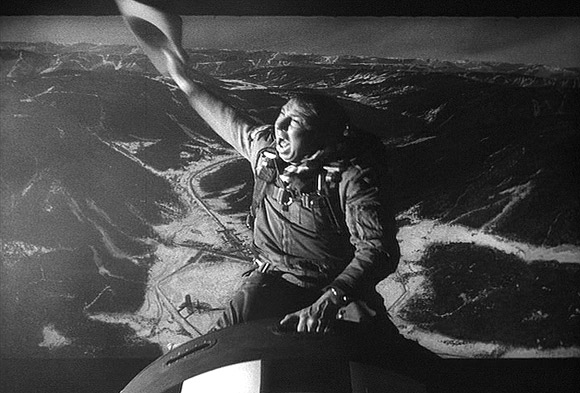
The entrance of the Soviet nuclear power onto the world stage created in the average American an unprecedented dread of death. And like the soldier cleaning foxhole mud off his boots before another day’s slog, the performance of daily tasks in the face of that dread created an absurd tension in American life. We spend so much time trying to stay ahead of death, squeezing happiness and purpose into our lives, that when the threat of death graduated from far-off abstraction to an any-day-now weapon from an across-the-ocean nation, it was like a cosmic joke. It’s an absurdity that would pervade the arts in the decades that followed, including two of the shortlisted novels for the 1962 National Book Award, Joseph Heller’s Catch-22, and J.D. Salinger’s Franny & Zooey. This is the tension that takes up residence in the subconscious mind of Walker Percy. And its vessel was Binx.
In The Moviegoer, the first reference to the Cold War comes toward the novel’s end. Binx is on a business trip to Chicago, and the passenger with which he shares a train car is reading the paper. Suddenly, he finds an article worth saving: “Scientist Predicts Future if Nuclear Energy is Not Misused.””Out comes the gold pencil to make a neat black box… after reading for a moment he comes back to the beginning and is about to make a second box, thinks better of it, takes from his pocket a silver knife, undoes the scissors and clips the whole article, folds it and place sit in his wallet. admire the man for his neat and well-ordered life, his gold pencil and his scissors-knife and his way of clipping articles on the convergence of sciences…” So the newspaper promises an American man a future in a time of peril, and his reaction is mundanely stupid: to clip it out and save it as if it’s a coupon.
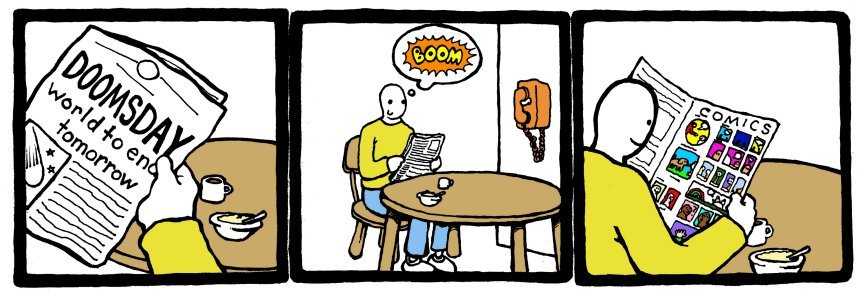
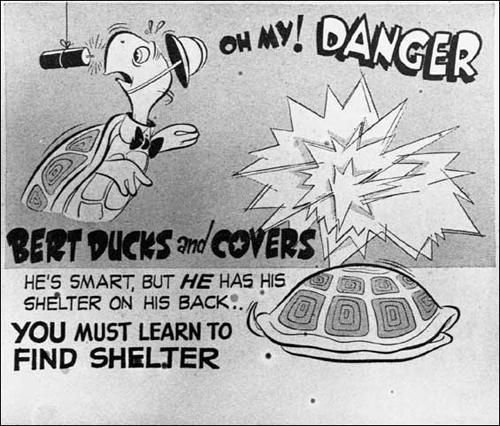
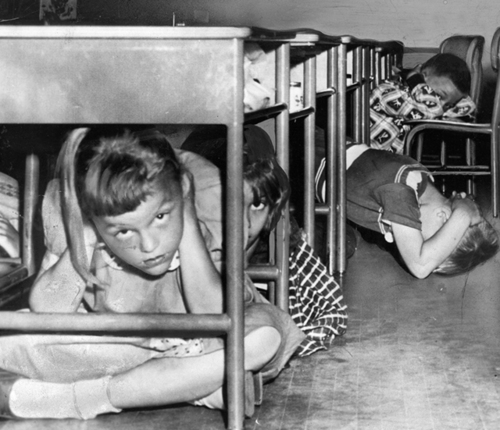
Despite the duck and cover drills, the advertisements for fallout shelters, the horrific drama of McCarthy’s inquisition, millions of Americans made this absurd choice every day: to get up and go to work in the morning, to do the dishes, to kiss the foreheads of their children before bed. The continuing threat of nuclear annihilation elevated the significance of daily living to something like a derivative of heroism. The Moviegoer may lack narrative thrust, but any study of a character like Binx would rightly have none. He does very little, and does not even see a film, as the title might suggest. Rather, Binx documents humanity’s death drive with his preoccupation with driving fast and his cousin Kate’s smoking and self-harm. He catalogs the nervousness of his family, and the way his own emotional intelligence has devolved into a crude physicality.
Binx chooses to occupy a dead world wherever possible. Like an emergency responder, he is a detective of aftermath, of the meaningless left-behind traces of human life. He is a stick in the mud, observing what the tide deposits on the beach of his life. The novel is replete with images of ruin, of a world emptied of humanity but still thick with our waste. The local movie-house on Freret Street, where Binx once saw The Oxbow Incident, has “old seats, their plywood split, their bottoms slashed, but enduring nonetheless.” (p. 69) When he visits his cousin Kate, she is “sitting at her ease in a litter of summers past, broken wicker, split croquet balls, rotting hammocks.” On a trip with his secretary Sharon, they take a boat to the Civil War era fort on Ship Island. Binx finds nothing edifying about the visit; “it is the soul of dreariness, littered with ten summers of yellow Kodak boxes and ticket stubs and bottle caps.” (p. 114). When Kate and Binx return to Canal Street after Mardi Gras, they find the “street cleaners sweeping confetti and finery into soggy heaps in the gutters.”

When it is suggested by an associate that Binx step outside his comfort zone and secure some contracts in Chicago, Binx reveals that “for some time now, the impression has been growing upon that everyone is dead.” (p. 86). The specter of death and radiation is reinforced throughout the novel with Binx’s x-ray vision. In many scenes, he seems to look past the skin and into the body in a disconcerting way. As Kate balances a coke bottle on her knee, he laments the “structure of it, tendon and bone, facet and swell, gold all over.” (83). His uncle massages him, “feeling the bones of my shoulder like a surgeon.” When his mother suggests that he find a more fulfilling line of work, like cancer research (her suggestion), he says simply, “Oh.” A nearby egret takes flight, “so close that I can hear the gristle creak in his wings.” The elegant motion of the egret is subverted by this focus not on its musculature, but the gristle which is employed like some anatomical slur.
Those that retain some property of the living have a death wish. Kate’s cigarette ritual is meticulously documented; she extracts the “wadded pack, kneading the cellophone, taps a cigarette violently and accurately against her thumbnail, lights it with a Zippo worn smooth and yellow as pocket watch.” The click of her lighter completes this ritual of death, connects it the clicking second hand of a metaphorical watch, an instrument that measures out units of life. Finally, “she blows out a plume of gray lung smoke.” One of Kate’s nervous tics is to pick at her thumb. In one scene, her thumb is mentioned several times, graduating from a small bleed noticed by Binx: “She presses her bleeding thumb to her mouth” (70) to intentional harm: she “tears shreds of flesh from her thumb” (71). To question her habit for self-destruction is to confront humanity’s irrational nuclear armament.
A nervousness is at work within the interactions of Binx and of the Bolling family. He reflects on small talks, saying “…it seems that the conversation is spoken by automatons who have no choice in what they say. I hear myself or someone else saying things like ‘In my opinion the Russian people are a great people, but-” and I think to myself: this is death. Lately is is all I can do to carry on such conversations, because my cheek has developed a tendency to twitch of its own accord.”
At dinner, Binx’s aunt pays no attention to any of the guests, and instead, “methodically combs the grooves which represent the lion’s mane” on the edge of her chair rail. His friend Sam, as he tells a long story, “irons out the tablecloth into shallow gutters with the blade of his knife.” For a close family, nobody seems very comfortable, and Percy takes us on a tour of each person’s nervous tics. Binx then shares a strange vision, of “the new messiah, the scientist-philosopher-mystic who would come striding through the ruins with the Gita in one hand an a Geiger counter in the other.” A strange vision: a destroyed world and when its Messiah comes, it carries a device for detecting radiation in addition to a holy book.
His cousin Nell is more optimistic. Her goal is to “make a contribution, however small, and leave the world a little better off.” But Binx recoils at this humanism: “Looking into her eyes is an embarrassment.” She continues, saying she doesn’t find life gloomy, but, rather, “books and people are things are endlessly fascinating. Don’t you think so?” He says yes, but “a rumble has commenced in my descending bowel, heralding a great defecation. As Nell departs, promises are made, “come see us, Binx!” “I will!” We part laughing and dead. (88, 89). The grin of a skull. He turns the radio on, tuning into a corny program of moral fiber, “This I Believe” in which the show’s host says “I believe in freedom, the sacredness of the individual and the brotherhood of man.” As he switches off the radio, he lies in bed “with a pleasant tingling sensation in my groin, a tingling for Sharon and for all my fellow Americans.”
His emotional connection to mankind is corrupted, replaced by a crude empathy of the body, in which other people’s positive outlook makes him want to defecate, and any joy he feels for humanity manifests itself in his pants. No, there’s nothing absurd about sex for Binx. His cousin Kate’s ass makes him blush because it “is a very good one, marvelously ample and mysterious and nothing to joke about.” (p. 35)

But he does experience other joys: his red MG. “It is a miserable vehicle actually, with not a single virtue save one: it is immune to the malaise.” In “Blues,” Dylan finds the same joy driving a 42′ Cadillac: “it’s a good car to drive, after a war.” The postwar boom was an advertising Renaissance, with pressure to find happiness through consumption, of goods, cars, houses, to assume a place in the suburban lifestyle template. Kate isn’t having any of it. “It’s all so monstrous,” she says, with exasperation, on their train journey to Chicago. Binx presses her. “I’m not up to it,” she says. “Seeing hubby off in the morning, having lunch with the girls, getting tight at Eddie’s and Nell’s house… raising my two lovely boys and worrying for the next twenty years if they will make Princeton.”
Binx has a strange imagining during a transitive moment late in the novel. As he enters Chicago, anxiety takes hold of him, “flaps down like a buzzard on perches on my shoulder.” The city of Chicago has what he calls a genie-soul, fortified by the “five million personal rays of Chicagoans and the peculiar smell of existence here,” which he must “sniff and get hold of before taking a single step from the station.” This genie-soul is like a sudden phalanx of identity beset upon him, a sum of history, culture, opinion, and quality that defines every place in the world. It overwhelms. We know this because when Binx describes his home in the suburb of Covington at the beginning of the novel, he speaks of its “attractive lack of identity, lack of placeness, even lack of history” (6).
After arriving in the train station, his frustration mounts: “if only somebody could tell me who built the damn station, the circumstances of the building, details of the wrangling between city officials and the railroad, so that I would not fall victim to it… Every place of arrival should have a booth set up and manned by an ordinary person whose task it is to great strangers and give them a little trophy of space-time stuff….” Fifty years later, the rise of the Internet has given us so much context and fact that we define our existence by it. The Information Age. Maybe our anxiety will be quelled, or we’ll swim in our data until our heads explode.

Binx’s aunt gives him an unprecedented dressing-down in the final act of the novel (highlight reel: “I do believe you are not capable of caring for anyone… I did my best for you son, I gave you all I had… I wanted to pass on to you the one heritage of the men in our family… the only good things the South ever had… Ah well. But how did it happen that none of this ever meant anything to you?”)
Brutal stuff. The matriarchal standard-bearer, the protector of the Order of Things, brandishes a letter opener throughout. Finally, “my aunt sheathes the sword and places her hand flat on the desk.” She is like a knight delivering a hard speech on chivalry to a lazy squire. It’s fitting perhaps for Binx to notice that her upholder of justice, her sword, is a miniature, a letter opener with a bent tip.
The novel concludes with his thirtieth birthday. He responds to this reminder of his mortality with a depressing thought: “… the malaise has settled like a fallout and what people really fear is not that the bomb will fall but that the bomb will not fall…” (p. 200) Binx’s world always feels close to the dead world of extinction that he imagines. “Is it possible that— For a long time I have secretly hoped for the end of the world and believed with Kate and my aunt and Sam Yerger and many other people that only after the end could the few who survive creep out of their holes and discover themselves to be themselves and to lie as merrily as children among the viney ruins. It is possible that—it is not too late?” (p. 201)
Percy’s Moviegoer submerges the reader in the anxiety of the nuclear age. As a Catholic, perhaps Percy’s deliverance from dread is a gift only God can give people. He was too early for the indulgences of today: the 24 hour news cycle, the echo chamber of Twitter, and the dank memes that give us a reason to get up in the morning. I think Binx would enjoy it all very much.
 keith fields
You must be logged in to post a comment.