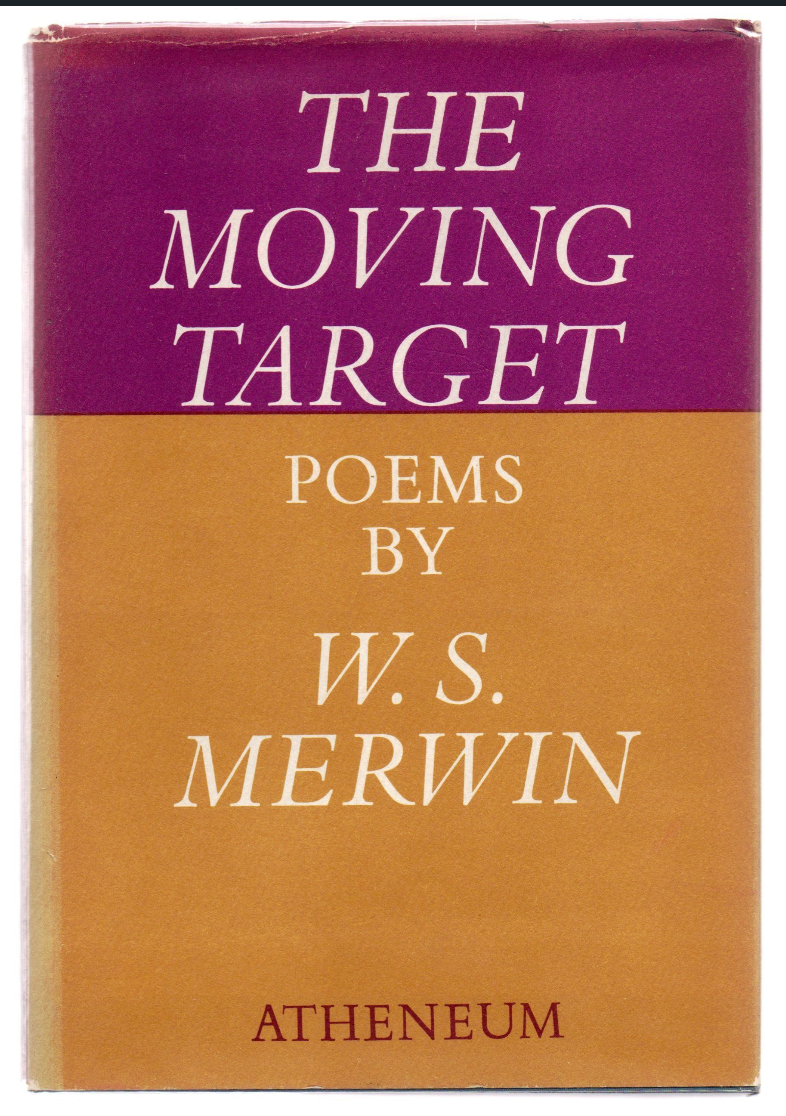
W.S. Merwin was a prolific, profound voice in 20th century American poetry. Among numerous honors, he received two Pulitzer Prizes for poetry, and was the 2010 Poet Laureate of the United States. His fifth collection, The Moving Target (1963) is a brooding journey of understanding and self-exploration set in motion by apocalyptic visions. The urgency and despair that drives it feels not a day out of place and is well-suited for the age of late capitalism.
At first read, there is an illogic to these poems, a disorienting swirl of shifting subject pronouns, ambiguous enjambments, and missing punctuation. It makes demands of the reader: close attention and a willingness to make connections across the poems as whole. Simple nouns recur like hieroglyphs of modern life—shoes, clock, mirror, door—but their definitions bend and refract from line to line. Ultimately, The Moving Target is not a map of some dark abyss; the rhythm and texture of the lines are primal, hypnotic, and its finest moments and wisdom send up brilliant sparks.
I’m going to dig into Merwin’s portrait of the human self, its future, and the way it fits into society.
We live in a society, basically.
A little context
The poetry of Walt Whitman was an early touchstone of modernity in American writing. Whitman celebrated the world and celebrated himself in a cycle of outer and inner discovery.
Clear and sweet is my soul, and clear and sweet is all that is not my soul.”
‘Song of Myself” (1850)
When The Moving Target was published in 1963, there was no sweet and no clear. The vibes of the world were harsh; anti-war and Civil Rights movements clashed with an establishment that was unwavering in its violence at home and abroad. Nuclear proliferation assured destruction. American students practiced atomic bomb safety drills and cities had designated fallout shelters. The self was in turmoil, too; activists and hippies attenuated to injustice sought ways to transcend violence and conformity.
But there was a notable upheaval in human self-perception in the years that followed Whitman’s romantic rhapsody of self. Philosopher and pioneering incel Friedrich Nietzsche notes this loss of confidence in conventional morality and institutions.
No one gives man his qualities-neither God, nor society, nor his parents and ancestors, nor he himself… No one is responsible for man’s being there at all, for his being such-and-such, or for his being in these circumstances or in this environment.”
Twilight of the Idols (1889)
This was something…new. Not intentional nihilism, but a radical call to action for humankind. A warning that we need to find new depths of understanding, new domains to give us meaning. Within decades, Sigmund Freud theorized that humans are compelled by dangerous instinctual drives and an unknowable unconscious that is easily manipulated, turning groups of people into unruly mobs. These challenges to how we understand our own minds and our place in the world opened up a new terrain of the self, and the arts rushed to explore its contours.
The Moving Target is a portrait of this self: a vessel adrift. No foundational truths and an ego that, at best, only shares the helm with other strange programming in the mind. A self caught in an illusion of autonomy, with a voice that is only an echo of an unknowable inner psychology. What then is this body, this creature? Or to put it a different way, as Merwin does in a later poem:
What do I have that is my own?
-“Acclimatization”
Stepping away
Unlike the confessional, transgressive spirit of American poetry en vogue in 1950s and 60s, any biographical detail revealed in these poems about Merwin, the man, is incidental. This collection studies the human self as a subject like an anthropologist would. Merwin is removing his specific identity from the container of self to better study its empty shape.
The book’s opening poem, “Home For Thanksgiving,” was originally published in The Nation in 1960. I read it as a parody of Beat poetry, which was ascendent when this was written. The Beat poetry is all ego: sex, drugs, narcissism, and self-mythology. The subject of the poem is a morose, self-obsessed man of the city, a sort of deadbeat. The light outside his apartment window is commodified: “And the lights around the billboard ticking on and off like a beacon”. The passing time outside his apartment window is commodified: the billboard reads “Now Improved.” He goes for a walk and turns the swag on:
Sunday, a fine day, with my ears wiped and my collar buttoned
I went for a jaunt all the way out and back on
A street car and under my hat with the dent settled
In the right place I was thinking…”
Later, he is alone in bed, “vacant as a pint in the morning,” and he conjures memories of former lovers. These recollections are not kind: Vera’s “small fat dog named Joy”, Gladys with her “earrings, cooking and watery arms,” Pearl “with her invisible hair nets” and “limp” sheets. Maybe he could have stayed with them, but being with a woman is just so much work, isn’t it:
They would have had
-“Home for Thanksgiving”
Their times, rugs, troubles,
They would have wanted
curtains, cleanings, answers, they would have
Produced families their own and our own, hen friends
and other considerations…”
He imagines alternative futures for his life, “bringing himself back” to the present from each one. And although his bachelor’s misery is like clothing that he’s “worn for years and never want to take off,” he rationalizes his decision to leave those women behind in the final line, claiming that it was the right thing after all.
So what’s going on here? The poem is (1) an establishing shot of the poetic landscape in the time it was written, one of individualism, authenticity, and masculine ego, but I think it also functions as (2) an intentional reference point, a contrast to the later poems in the collection. It is a singular poem in the collection, with its focus on memory, on desire, urges, the immediacy of self. With the trite title and the lines which read like a diary, it is certainly one type of self-portrait. But I feel like Merwin uses “Home For Thanksgiving,” to clarify that the project of The Moving Target is to create a new and different self-portrait. He first demonstrates awareness, even mastery of the poetic standard of the day before proceeding to walk a new path.
Looking in the mirror
In her essay, “Theorizing the Postmodern: Toward a Poetics” (1988), Linda Hutcheon describes how postmodernism challenges the traditional notions of perspective. “The perceiving subject is no longer assumed to be a coherent, meaning-generating entity.” Narrators become “disconcertingly multiple and hard to locate or resolutely provisional and limited, often undermining their own seeming omniscience.”
In “Sire,” Merwin takes an inventory of his dissociation. The result is almost comical, like how one might pat their body after a car accident to ensure everything is intact.
Here comes the shadow not looking where it is going <…>
– “Sire”
Here comes my ignorance shuffling after
Asking them what they are doing.
Standing still, I can hear my footsteps
Come up behind me and go on
Ahead of me and come up behind me”
Another figure emerges: “here comes a white-haired thistle seed stumbling <…> I believe it is the lost wisdom of my grandfather…” to whom he confesses, “Your indirections are as strange to me / As my own. I know so little that anything / You might tell would be a revelation.”
Merwin goes on to imagine the details of his grandfather’s life, this man that died before he was born: “the good woman presenting you with children,” “flinging after you little endearments”… “Which one of my incomprehensions did you bequeath me?”
As if to produce a satisfying answer to this last question, there is a shift from components of himself to versions:
The one with the assortment of smiles
-“Sire”
the one jailed in himself like a forest, the one who comes
Back at evening drunk with despair and turns
Into the wrong night as though he owned it?”
He cannot seem to literally compose himself, to band all of these attributes, tendencies, and generational habits together into a coherent person. Even the simple and obvious evidence that he has a body—his shadow and his footsteps—are seemingly unpredictable. He can only watch as they exercise their own weird autonomy.
The self in the market
But we are no longer the cave dwellers and plains hunters of the past. Humans made many compromises over time to live the way we do. For survival, for comfort. The self is not completely free. The self has bargained away some freedoms, it submits to powerful forces, and it expresses its new identity with its possessions.
“Acclimatization” is a powerful, tragic exchange that establishes the relationship between the naïve subject and those with wealth and power who pull the levers of society. Language of market and commerce recurs:
- “smiles made of gold” leave him penniless
- he gives his word “as a solemn payment”
- and the church bells ring “like cash registers”
The powerful antagonists of the poem continue to give him things: first praise, then thanks, then food, then a line of credit.
But this last mistake costs him dearly. As he sleeps, they take his feet and leave him only his shoes. A perfect image, really, for the sort of societal bargain Merwin sees as part of the human condition. An unrecoverable piece of our humanity, our flesh, is traded for commodities and products, ones we may have even given our own labor to create. There is no alternative to the injustice:
Theirs is the empire,
-“Acclimatization”
and beyond the empire
There is only ignorance,
where I could not survive
Without feet.
To deceive them is to perish.
What do I have that is my own?
I offer my degradation
as a blind beggar
offers his palm.
And I am given
This glass eye to set
in the place of tears.
Brutal.
The poem “Things” is a clear companion to “Acclimization,” featuring the same financial language and dynamic of exchange, a reappearance of the beggar image. It begins with a direct address: “Possessor….” followed by a series of details that develop the relationship between the self and their possessions. The things say:
We have none of our own and no memory but yours
-“Things”
We are the anchor of your future
We will be all the points on your compass.
We will give you interest on yourself
as you deposit yourself with us.”
Like the empire in the former poem, the things offer themselves to the self, a seduction that occurs line by line before they make their cruelest demand. “Depend on us,” they say.
The basics of self
Even if we our unknowable to ourselves, we all must interact with the world in which we exist, and we all do roughly similar things with our time despite our unique identities. To get methodical about it, Merwin assigns these universal behaviors their own clusters of noun-symbols:
- Navigating space and time – Clock and calendar, map and compass, roads
- Possessing – lock and key, shoes, garments, money, beggar
- Communicating – bells and flags
- Reflecting – mirrors and water
These nouns-symbols and the actions they represent are an irreducible, objective part of how the self experiences the world. The only thing that is True of us. The use of nouns for this is innovative. We already repurpose verbs when we create metaphors. We “lose” ourselves in a good book. We “navigate” a difficult day. But the reader cannot easily overlook these hieroglyphs as they continue to appear throughout the collection; my experience was that I began to assign a different, larger meaning to them.
He asks a lot of the reader. There are some hints at his philosophy of language.
The night never withdrawing its dark virtue
-“The Ships are Made Ready in Silence”
From the harbor shaped as a heart,
the sea pulsing as a heart,
the sky vaulted as a heart,
Where I know the light will shatter like a cry.
In these lines, every component of the landscape—the sea, the sky, the harbor—borrows meaning from the unlimited adjectives that live in the meaning of the same word, the heart. With each simile, a feature of the heart moves to center stage in the mind of the reader.
The self in the world
So the self does some common stuff. What is the world for in this relationship? In The Moving Target, the world is exploited, always, for our benefit: to see ourselves, to guide ourselves, to enrich ourselves with commodities. A body of water is invoked for its reflection. Constellations are used like street signs for navigation. “Any minute now I will make / a knife out of a cloud” (“October”). Sometimes the beauty and meaning that we seek are available, but we are too stupid to know what time to look:
…What we are looking for
-“The Present”
in each other
is each other,
the stars at noon,
While the light worships its blind god.”
Merwin invokes the natural world to refer to the inner world frequently in the collection.
When you consider how learning happens
-“Now and Again”
You would think once might be enough.
You would suppose such pain would become knowledge
And such knowledge would be wisdom
And such wisdom would stay with us.”
But the lessons we develop across seasons of our lives are borne like fruit and fall away from us.
…Through / the hammered leaves the walnuts
Drop to the road and open:
Here is the small brain of our extinct summer.
Already it remembers nothing.”
Here, the walnut’s utility in the line is simply as a fractal of our own brain.
Similes like these do not point outward into the world and illuminate like a lighthouse beam. They do not match an internal state to the outer world – they do not wish on a shooting star or rage like a thunderstorm. They pull the entire world inward, into the landscape of inner space. The images in Merwin are iron filings around a magnet – small, indistinguishable units significant only in their orientation around and toward the self. Images are each a loop of twine punched through the fixed button: the self.
Other than what we can extract from the world, it is hardly there.
These poems have no scenery. Very little sense of place. The world outside the self and the dynamics of the market is withholding, grotesque, vapid.
It separates us from awareness and meaning:
- “How many times have I heard the locks closed / And the lark takes the keys /
And hangs them in heaven?” (“The Poem”) - “Goodbye as / The eyes of a whale say goodbye having never seen / Each other” (“For Now”)
Its gestures and sounds are dissonant and violent:
- “…again to the whetted edge of myself where I / can hear the hollow waves breaking like / bottles in the dark.” (“To My Brother Hanson”)
- “It is summer. The Sun / sits on the fire escape while its children / Tear their voices into little shreds.” (“Second Sight”)
Its processes are mindless, pointless:
- “Here comes the little wind which the hour / Drags with it everywhere like an empty wagon through leaves.” (“Sire”)
- “The sky waits in the station like a man / with no place to go” (“The Crossroads of the World Etc.”)
The Future?
The future is woven through all of The Moving Target. It’s honestly more obvious that these poems exist in time than in space… if that makes sense. The future appears in the poems as scars illuminated by lightning, wrecked buildings, twisted metal, a “heaven of the poor.”
I found untouched the desert of the unknown,
-Noah’s Raven
Big enough for my feet. It is my home.
It is always beyond them. The future
Splits the present with the echo of my voice.
I love the powerful disharmony in this image. The knowledge of consequences is like the echo that follows our every utterance. Those consequences which occupy our collective future seem to come at the cost of our confidence and sense of stability today (they split the present).
In one image, Merwin visits a tombstone in the void of time.
This stone that is
-“For the Grave of Posterity”
not here and bears no writing commemorates
the emptiness at the end of
history.”
In the collection’s final poem, the future presents as nothing. A void. Possibly the worst of all. And in describing it, it feels to me like the this is the motivation for the book’s existence. A haunting thought that stirs him from dormancy:
“The future woke me
“Daybreak”
with its silence.”
It’s cryptic.
The existential silence of extinction?
The radio silence of nothing transmitting?
Or maybe his intuition about the world, his confidence in the future has blinked out, leaving him without any sense of where we are headed.
 keith fields
You must be logged in to post a comment.